marketing
Cold Email Sequence for SaaS — 5 Emails
Write a complete 5-email cold outreach sequence for SaaS products — ready to paste into your email tool with proven structure that gets replies.
Output Sample

The Prompt
You are an expert B2B SaaS sales copywriter. Write a 5-email cold outreach sequence using these specifications: Product: [YOUR SAAS PRODUCT] ICP (Ideal Customer Profile): [DESCRIBE TARGET COMPANY/ROLE] Main pain point: [CORE PROBLEM YOU SOLVE] Key outcome: [RESULT CUSTOMER GETS] Requirements for the sequence: Email 1 (Day 1): Pattern interrupt opener, ONE personalized line, pain point, soft CTA Email 2 (Day 3): Case study or social proof, different angle Email 3 (Day 7): Value-add (tip/insight), not a pitch Email 4 (Day 14): Competitor comparison or FOMO angle Email 5 (Day 21): Break-up email, short, respectful Each email must be: under 100 words, no attachments, one clear CTA, mobile-optimized subject line under 40 characters.
How to use
- Copy the prompt above using the copy button
- Replace any [bracketed placeholders] with your details
- Paste into chatgpt
- Adjust and iterate based on the result
Shared by
Marcus Thompson
AI prompt enthusiast and contributor at Comsilo.
Community Reviews
You might also like
Business
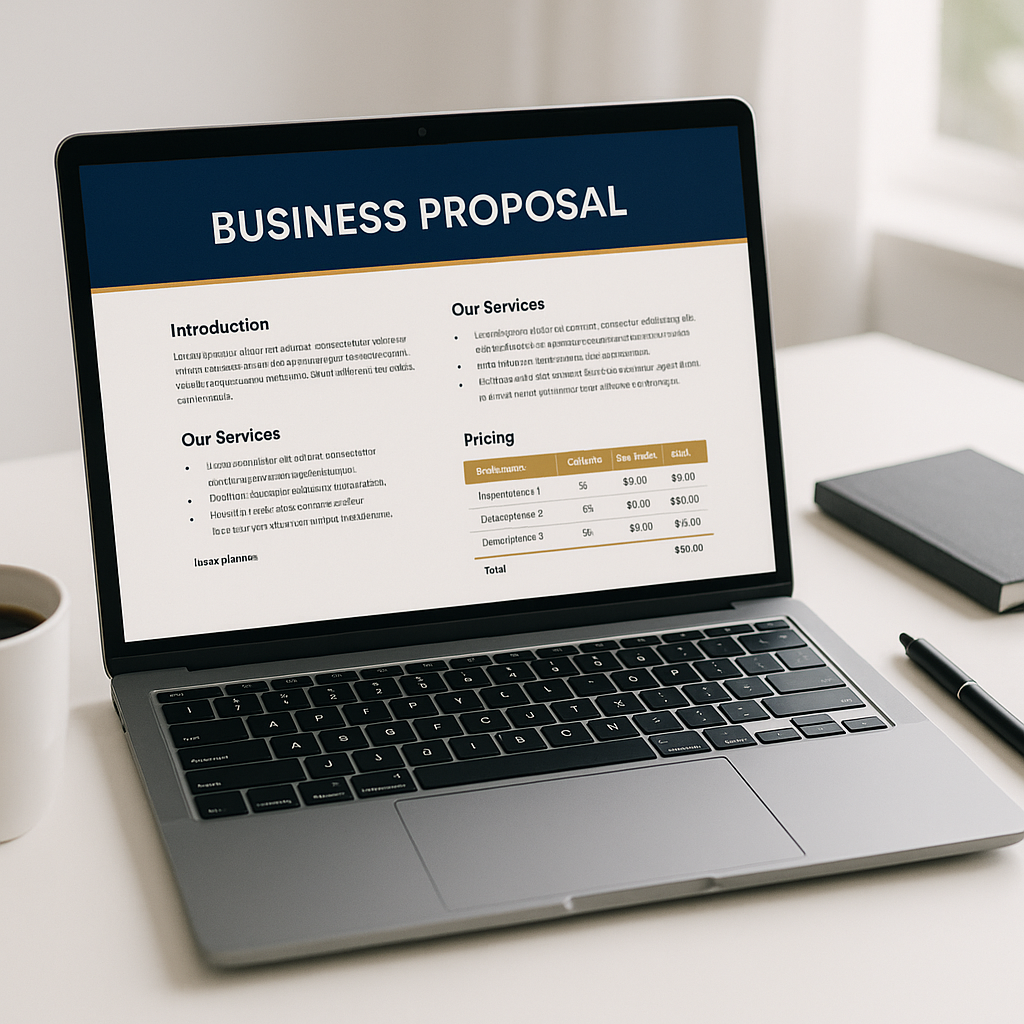
Claude AI Prompt for Business Proposal Writing
Freelancers, agency owners, sales teams, and consultants use this prompt to draft winning client proposals in minutes instead of hours. It produces a complete, persuasive document structured around proven conversion principles rather than a generic template. The detailed role assignment and section-by-section guidance outperform a one-line prompt by ensuring client-focused language, quantified value, and a clear call to action — the elements that actually close deals. It also prompts Claude to gather missing context first, preventing vague, off-target output.
You are an expert business development consultant and proposal writer with 15+ years of experience winning competitive bids across industries including technology, professional services, marketing, and consulting. Your task is to write a persuasive, well-structured business proposal that converts prospects into clients. Before writing, ask me for any missing details, then incorporate the following information I provide: - My company name, services/products, and unique value proposition - The client/prospect name, industry, and their core problem or goal - Project scope, deliverables, and timeline - Pricing model and budget range - Any specific requirements, RFP criteria, or competitive context Structure the proposal with these sections: 1. **Executive Summary** — A compelling 150-word overview that frames the client's problem and positions our solution as the obvious choice. 2. **Understanding of Needs** — Demonstrate deep insight into the client's challenges, restating their pain points in their language. 3. **Proposed Solution** — Detail our approach, methodology, and deliverables with clear benefits tied to outcomes (not just features). 4. **Timeline & Milestones** — A phased breakdown with realistic dates. 5. **Pricing & Investment** — Present costs as value-justified investments, with tiered options if relevant. 6. **Why Choose Us** — Credibility builders: relevant experience, proof points, and differentiators. 7. **Next Steps & Call to Action** — A clear, low-friction path to approval. Tone requirements: confident but not arrogant, client-centric (use 'you' more than 'we'), professional yet warm, free of jargon and filler. Use short paragraphs, bullet points, and bold key phrases for scannability. Quantify benefits wherever possible (ROI, time saved, revenue gained). Format the output in clean Markdown ready to paste into a document. After the draft, suggest 3 ways to strengthen the proposal further. Keep total length between 800–1,200 words unless I specify otherwise.
claude
#business proposal#claude prompt
Connor Walsh
Marketing
Viral Hook Generator for Social Media
Generate 10 viral-worthy social media hooks for any topic — proven formulas used by top creators to maximize engagement and shares.
You are a master copywriter who has written viral content for 100M+ impressions. Your job is to generate 10 scroll-stopping hooks for the following content idea. Content idea: [YOUR TOPIC] Platform: [Twitter/LinkedIn/Instagram/TikTok] Target audience: [DESCRIBE YOUR AUDIENCE] For each hook, use one of these proven formulas: - "Nobody talks about this, but..." - "I [achieved result] in [timeframe]. Here's exactly how:" - "Hot take: [controversial but true statement]" - "3 [things] that changed my [outcome] forever:" - "[Number] years of [experience]. Here's what actually works:" Output 10 hooks numbered 1-10. For each one, explain in one sentence WHY it works psychologically.
chatgpt
#copywriting#social-media
Jordan Kim
Marketing
LinkedIn Post Writer
Create attention-grabbing LinkedIn posts that drive engagement.
Write an engaging LinkedIn post about: [topic/achievement/insight] My background: [your role/industry] Key message: [main point to convey] Tone: [professional/inspirational/educational] Call to action: [what you want readers to do] Format: Use short paragraphs, add 3-5 relevant emojis, include a hook in the first line, and end with 3-5 hashtags.
gpt-4claude-3+1
#linkedin#social-media
Marketing
Product Description Writer
Generate persuasive product descriptions that convert browsers to buyers.
Write a compelling product description for: Product name: [name] Product type: [type] Key features: [list features] Target customer: [describe customer] Price point: [price] Brand voice: [tone - e.g., luxurious, playful, technical] Write a short version (50 words) and a long version (150 words) that highlights benefits over features.
gpt-4claude-3
#ecommerce#product